BWLK, Staking, and Voting
BWLK is Boardwalk’s protocol token. BWLK also functions as a consumption token, burned by users across all chains to launch a token economy and influence project discovery through Upvoting and Downvoting.
Fee-Direction Weight
A staker’s weight to vote-direct designated fees is called Fee-Direction Weight. It equals staked BWLK plus Voter Points.
Fee-Direction Weight = Staked BWLK + Voter PointsStaked BWLK is the base of voting weight.
Voter Points build at a 100% annual accrual rate while BWLK stays staked. They are non-transferable and have no monetary value. On unstake, Voter Points burn proportionally — a full exit burns the related points, and a partial withdrawal reduces points in proportion to what was removed.
12,000 BWLK staked + 2,820 Voter Points = 14,820 Fee-Direction WeightHow voting works
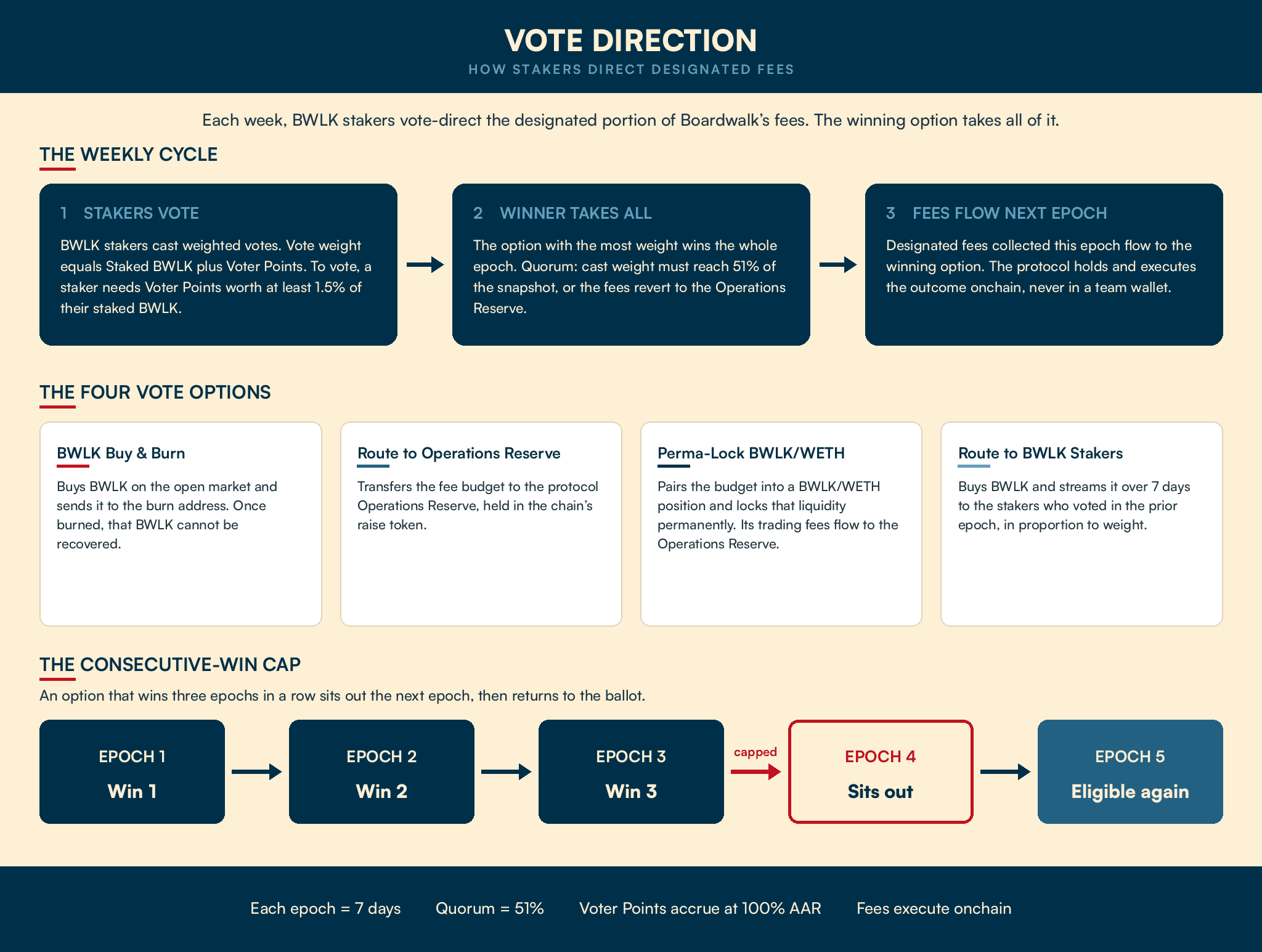
Voting happens in weekly epochs. During each epoch, BWLK stakers vote on where the designated portion of Boardwalk’s fees should be directed next. Votes cast in one epoch direct the designated fees collected in the following epoch.
Disclaimer: The amount that actually flows depends on protocol activity and may be low or zero.
The vote is winner-take-all. The option with the most support gets the routing for that epoch.
The designated fees directed each epoch are held onchain by the protocol, not in a team-controlled wallet. When a vote resolves, the contract executes the winning outcome automatically onchain.
The four vote options
Route to Operations Reserve — The fee budget transfers to the protocol Operations Reserve in the raise token.
BWLK Buy & Burn — The fee budget buys BWLK from the market and sends it to the burn address. Once burned, that BWLK cannot be recovered.
Perma-Lock BWLK/ETH — The fee budget is split in half. One half is swapped into BWLK. The two halves are paired into a BWLK/ETH liquidity position that is permanently locked. Trading fees from that position flow to the Operations Reserve over time.
Route to BWLK Stakers — The fee budget buys BWLK, then streams it over 7 days to stakers who voted in the prior epoch.
Eligibility: the 1.5% Voter Points ratio
To vote in a given epoch, a staker needs Voter Points equal to at least 1.5% of their staked BWLK. A staker with 1,000 BWLK staked needs at least 15 Voter Points.
Quorum
Boardwalk uses a 51% quorum — total Fee-Direction Weight cast must reach at least 51% of the snapshotted total. If quorum is not reached, the designated fees revert to the Operations Reserve for that epoch.
The consecutive-win cap
An option that wins three epochs in a row is ineligible the next epoch. After sitting out one epoch, it returns to the ballot.
BWLK Tokenomics
BWLK is Boardwalk’s protocol token. It functions as both a utility token and a consumption token across all chain deployments.
Supply. BWLK was deployed with an initial supply of 3,150,000 BWLK. The BWLK token contract has no minter and no post-deployment supply-increase function, which means no one — including the Boardwalk team — can create new BWLK. Supply can only decrease over time through burns. Reference the Migration Announcement for the BWLK supply allocation.
Deflationary by design. Several protocol actions permanently remove BWLK from supply by sending it to the burn address (0x000000000000000000000000000000000000dEaD). Tokens sent to this address cannot be recovered or re-issued.
BWLK burns when users perform specific onchain actions. Launching a token economy on Boardwalk burns a protocol-defined amount of BWLK from the issuer. Using Upvote or Downvote to signal on a token or auction burns BWLK as a one-way cost — each address can use one Upvote and one Downvote per token or auction every 30 days. Additionally, one of the four vote direction options (BWLK Buy & Burn) uses designated fees to purchase BWLK and send it to the burn address. Because these burns depend on actual protocol activity, the rate of supply reduction varies and may be low or zero in any given period.
Holding vs. staking. Holding BWLK and staking BWLK are different roles. Holders keep BWLK in a wallet and can use it for community signaling or launch creation. Staking creates eligibility to vote-direct designated fees in weekly epochs. For how Fee-Direction Weight works and how vote direction operates, see the sections above.
BWLK staking, Voter Points, and Fee Direction operate on Ethereum. BWLK is bridgeable to other supported Boardwalk deployments through official Chainlink CCIP routes but must be on Ethereum to stake, accrue Voter Points, and vote-direct designated fees.
Note: BWLK stakers direct a designated portion of Boardwalk’s fees through onchain rules — this does not imply broad control over every part of the protocol. See the Disclosures for the full statement of BWLK rights, fee-direction limits, and the Operations Reserve.
Primary BWLK Liquidity
Primary BWLK liquidity is on Ethereum. Reference the Migration Announcement for the verified BWLK contract address and liquidity details.
Community Signals and Discovery
Boardwalk includes community signals that affect how tokens and auctions appear in the default discovery view.
An Upvote moves a token or auction higher in the default discovery ranking. A Downvote moves it lower. Both burn BWLK as a one-way cost. Each address can use one Upvote and one Downvote per token or auction every 30 days.
The visibility score is total Upvotes minus total Downvotes. All Upvote and Downvote activity resets every 30 days.
Disclaimer: Community signaling can influence what users see first, but it does not change a token’s launch rules, fee setup, vesting schedule, or liquidity design. These are onchain signals from users, not team ratings, safety reviews, or recommendations.