Define and Launch a Token Economy
Choose the launch path
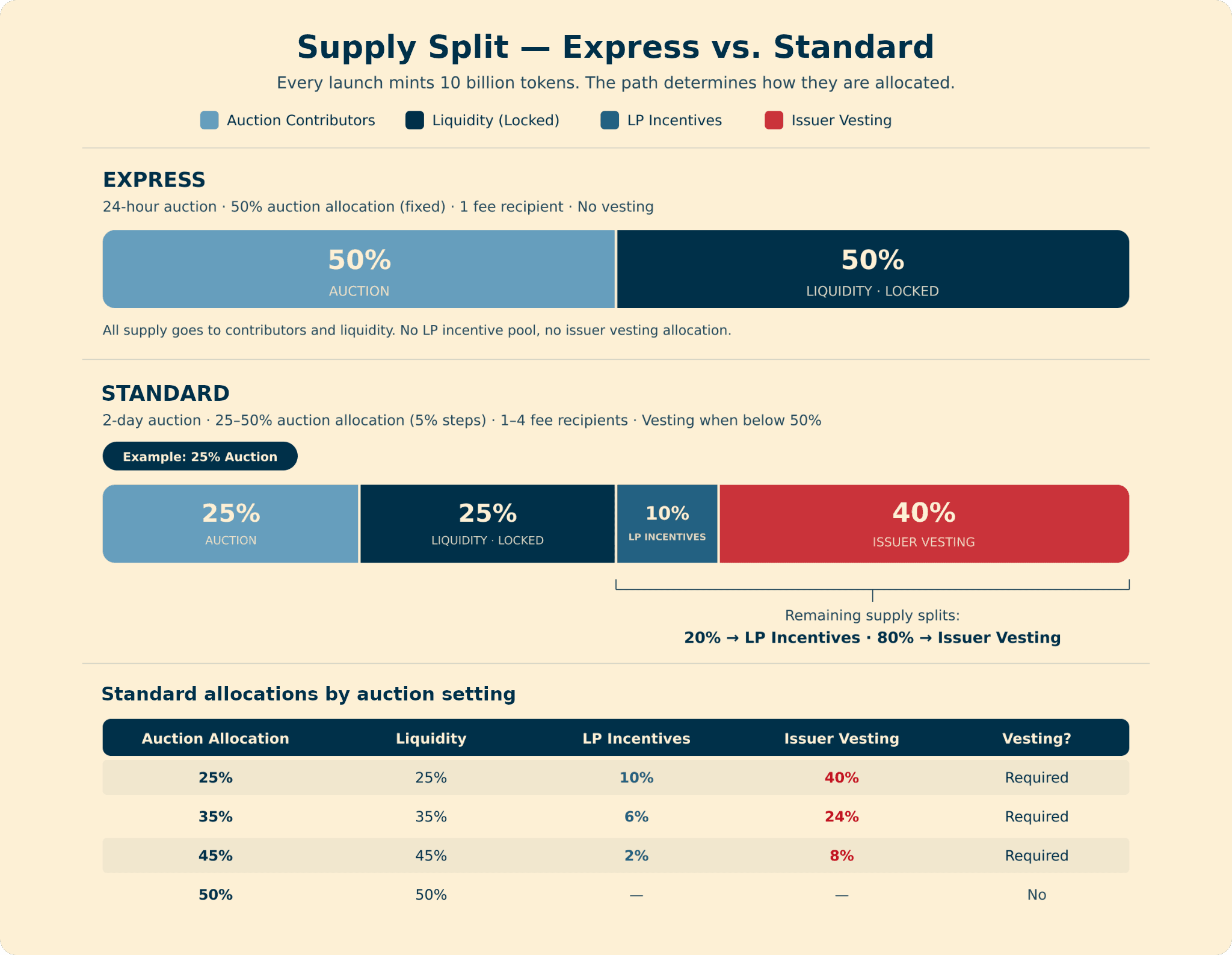
Standard is the flexible path. It uses a 2-day auction, supports an auction allocation between 25% and 50% (in 5% steps), allows one to four issuer fee recipients, can include a referrer, and supports vesting. When the auction allocation is below 50%, vesting is enabled, as the remaining supply gets split between LP incentives (20% of remaining) and an issuer vesting allocation (80% of remaining).
Express is the shorter path. It uses a 24-hour auction, splits the supply 50/50 between auction and liquidity, supports one issuer fee recipient, has no referrer, and includes no vesting.
Set the launch details
The issuer fills in the details users will see before they contribute: chain, name, ticker, logo, description, website, video, and social links.
Set the auction structure
The auction window and graduation threshold are static for all launches, as part of the Boardwalk standardization. Express uses a 24-hour auction. Standard uses a 2-day auction and 24-hour start delay. The graduation threshold is currently 2.5 ETH or the chain-specific raise token approximate equivalent (e.g. WETH on Base).
The issuer can set a goal for the raise — an optional target intended to communicate the amount of contributions sought from contributors. The Raise Goal does not cap the auction and does not replace the graduation threshold. Auctions have no raise limits.
How the supply is split
For an Express launch (50% auction): 50% goes to auction contributors, 50% pairs with the raised asset to seed liquidity. There is no LP incentive pool and no issuer vesting.
For a Standard launch (auction set between 25% and 50%): the auction percentage goes to auction contributors, an equal amount pairs with the raised asset to seed liquidity, and the remainder becomes the vesting pool. 20% of the vesting pool funds LP incentives. The other 80% goes to issuer-directed vesting.
A Standard launch with a 30% for auction would split: 30% auction, 30% liquidity, 8% LP incentives, 32% issuer-directed vesting.
For example, a Standard launch sets 35% for auction which results in 35% for pairing into permanent liquidity. The 30% remaining; 6% is directed to LP incentives (20% of the remaining), leaving the issuer with 24% to direct to chosen recipients.
Configure fee recipients
The issuer defines issuer-directed fee destinations and sets the address and percentage for each allocation.
Issuer is the person or team launching the token economy.
Entity is usually a treasury or working-funds address, often protected by a team multisig.
Referrer is typically someone who helped the issuer discover Boardwalk or get the auction set up. This is optional, and only Standard supports it. The referrer portion comes from the Boardwalk portion, not from the Issuer.
Public good is an optional destination for a cause or charitable organization.
Growth Team can be an individual, team, or entity helping grow the project and community through marketing, content creation, community management, business development, or other targeted initiatives.
Once the token is live, the core fee percentages are immutable for that launch. Addresses can rotate later through a timelocked address-change flow (see Technical Appendix), but the fee split itself does not change.
Configure token vesting
Vesting is Standard-only. When the auction allocation is below 50%, vesting is required.
Standard launches can support up to five vesting recipients, including a referrer.
Once initialized, the vesting schedule is fixed. Issuer-directed vesting starts after a 7-day cliff and then vests linearly over 3 years. Only destination addresses can change via a 7-day timelock process. When an address is updated, vested but unclaimed tokens for the old address are claimed before the new address takes over.
Vesting to LP Participants becomes active 24 hours after liquidity seed.
Who Can Change an Address After a Launch
A launch locks its economics when the issuer creates it. Fee percentages, vesting amounts, and vesting schedules stay fixed for the life of the token. Addresses are the one exception. Each address has exactly one owner who can move it, and every move runs on a timer.
| Address | Who can change it | Waiting period | Can be made permanent |
|---|---|---|---|
| Fee recipient (each address on the Fee-Direction step) | The person or team at that address. Each holder controls only their own address. | 7 days | No |
| Referrer | The referrer | 7 days | No |
| Vesting recipient | The issuer | 7 days | Yes, one allocation at a time |
| Integrator | The integrator at that address | 14 days | No |
How a change works
Every address change runs the same three steps. The owner signals the change. The waiting period runs. Anyone can then execute the change during the seven days that follow. If nobody executes it in that window, the change expires and the address stays as it is. The owner can cancel a signaled change any time before it executes.
What happens when a change executes
Fee recipients. Fees keep flowing to the old address until the change executes.
Vesting recipients. The change claims any vested tokens the outgoing address has not taken yet, then hands the allocation to the new address.
Integrators. The new address cannot be empty, and it cannot be an address another integrator already holds.
What the issuer cannot do
The issuer sets every fee address and every split when they create the launch. After the launch goes live, the issuer cannot change a fee address. Only the person or team at that address can change it.
This matters when an issuer sends fees to a partner, a public good, or a growth team on the Fee-Direction step. That routing becomes a commitment the issuer cannot reverse later.
One case looks like an exception and is not. An issuer who lists their own wallet can change that address, because they hold the address, not because they launched the token.
Vesting is the one place where the issuer keeps address control.
BWLK burn to launch
Currently it requires burning 100 BWLK to launch an economy on Boardwalk. This is seamlessly integrated in the launch process.